All Elite Wrestling | The Dogs
Turning a limited brief into a character-defining theme in 48 hours.
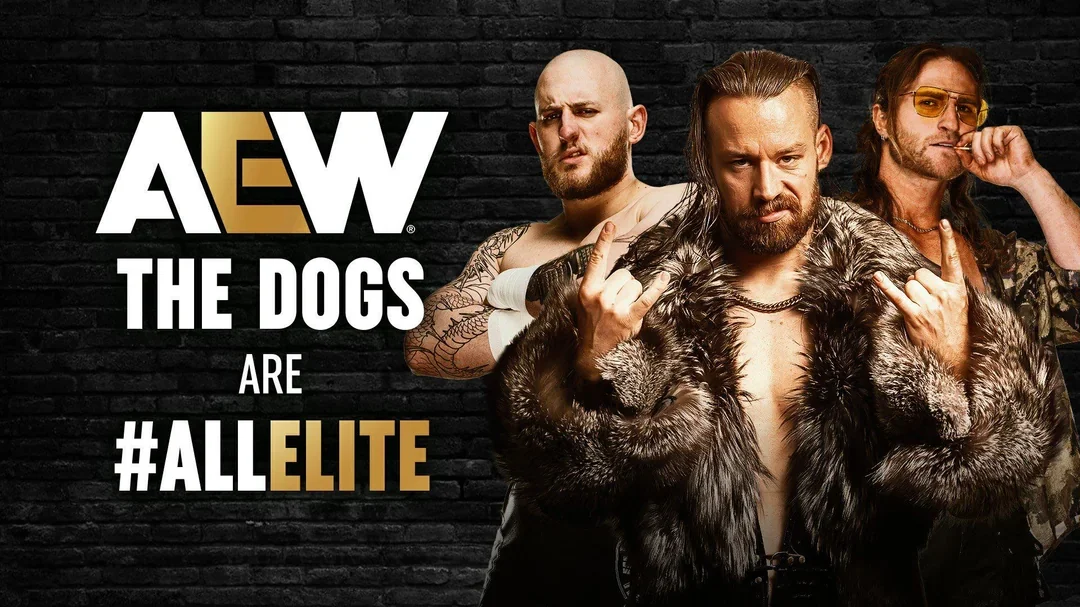
All Elite Wrestling needed an original entrance theme for The Dogs, a three-man faction making its AEW debut at one of their premiere Pay Per View events “Revolution”. I had less than 48 hours to turn a few lines of creative direction into a shared character voice that could represent three individual performers and connect with audiences inside and outside the world of professional wrestling.
Role: Writing + Voice/Performance
Creative Lead: Mikey Rukus, AEW Music Director
Deliverable: Original entrance theme
Timeline: Less than 48 hours
A theme built for a big stage.
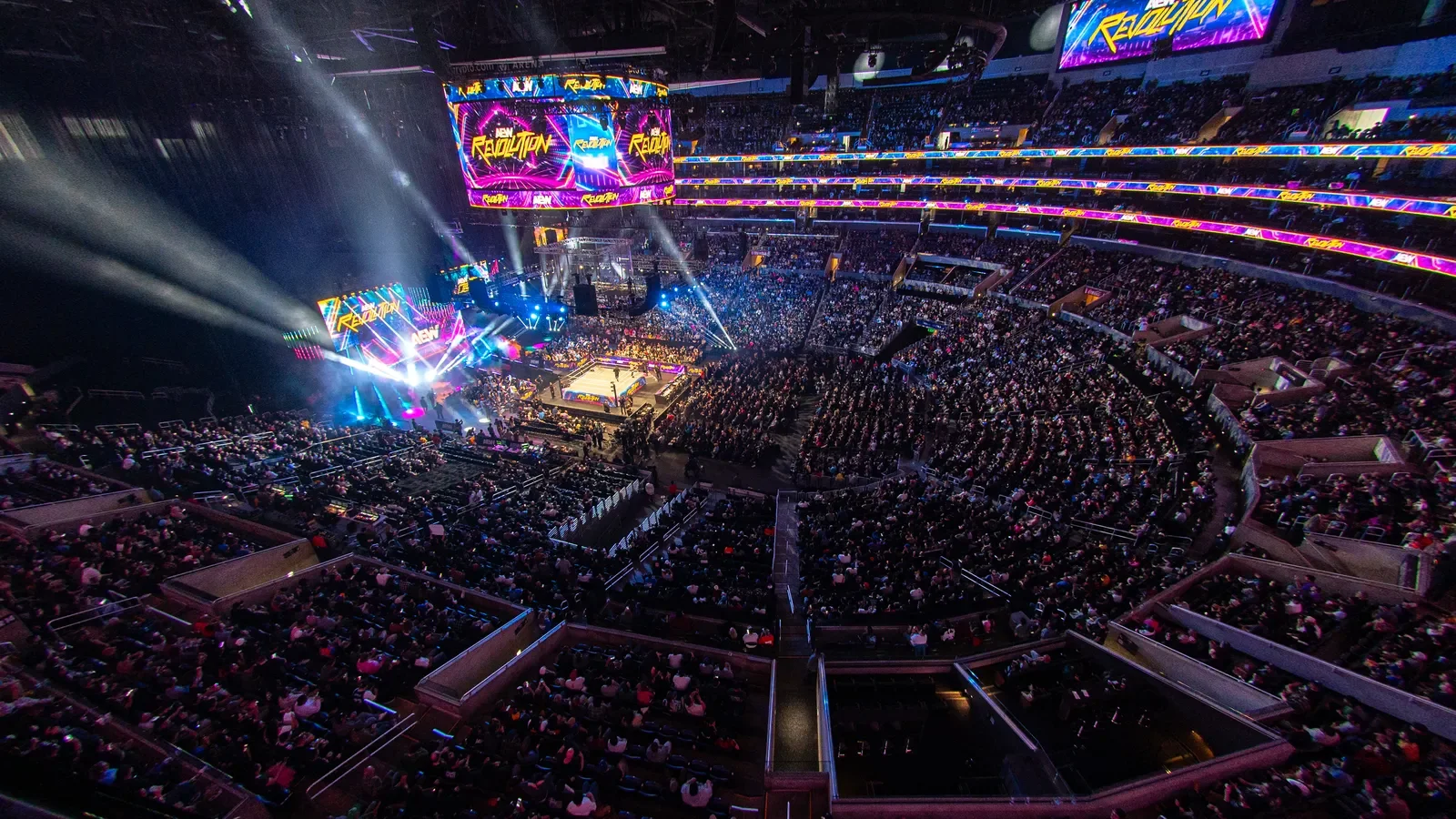
The Dogs weren't being introduced in isolation. Their new AEW identity would debut in front of a major live and television audience, with the theme immediately becoming part of how The Dogs were introduced and experienced.
12,590
Revolution attendance
$1.1M
Revolution live gate
~704K
Recent 10-week average for AEW Dynamite linear television viewership*
Estimated 150-175k PPV buys
*Linear television audience only. Does not include Max streaming.
The timeline left little room between concept and execution. The theme needed to be written, recorded, approved, finished and delivered in time for its Revolution debut.
The direction was simple. The writing problem wasn't.
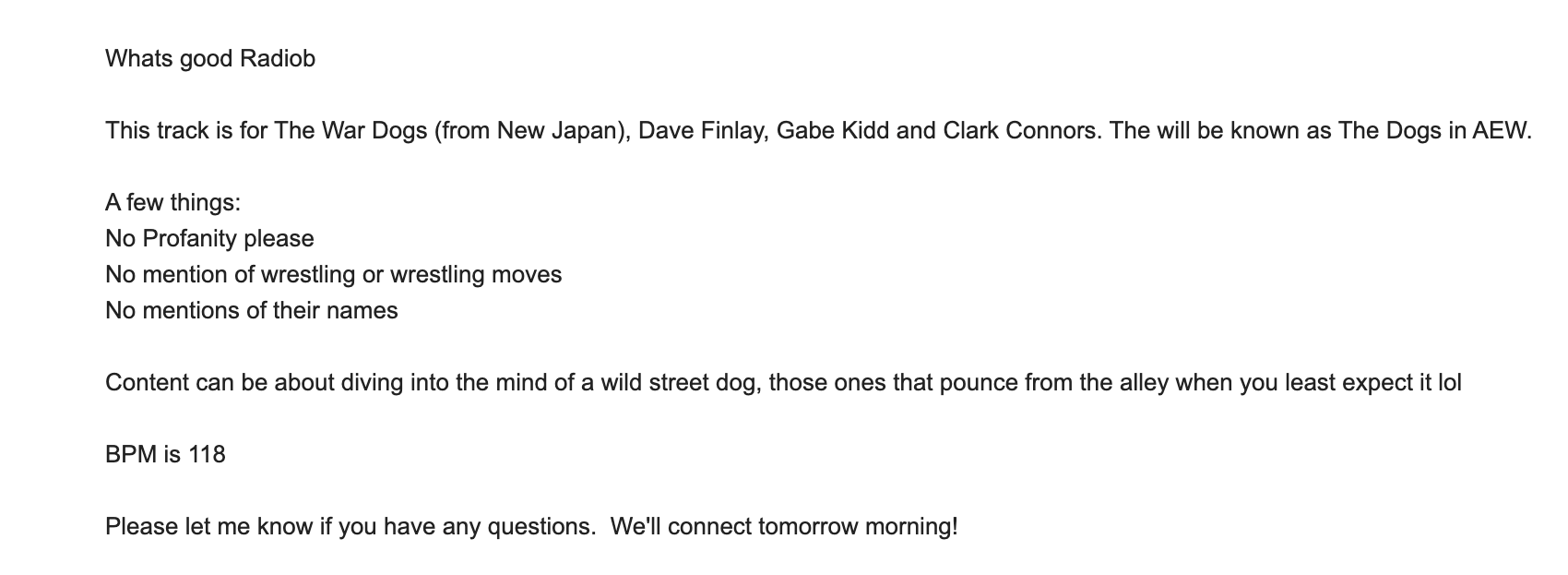
The initial direction from AEW Music Director Mikey Rukus established a basic creative territory: “wild street dog mentality.”
Then came the boundaries:
2 sets of 8 bars
118 BPM
No profanity
No performer names
No wrestling references or moves
Delivered Saturday
Debuting Sunday
I had the characters, a creative territory, a set of restrictions and a deadline.
The job was to figure out everything in between.
Reading Between the Lines
What has to remain true when a character enters a new context?
I was already familiar the the War Dogs and the attitude they had established in New Japan Pro Wrestling. AEW wasn't asking me to invent that identity. The challenge was translating what made it recognizable into a new presentation as The Dogs for a broader American audience.
The brief gave me the creative territory of a “wild street dog mentality,” but not the voice itself. I had to determine what three established individuals sounded like when speaking as one unit, what parts of their existing identity needed to carry forward, and how to communicate that without names, wrestling terminology or exposition.
The challenge wasn't inventing who they were. It was finding the language that made who they already were immediately legible in a new context.
Building the Character
I wasn’t writing about The Dogs. I was writing as them.
The brief gave me a metaphor: wild street dogs. The writing had to turn that metaphor into a point of view.
The first decision was perspective. Rather than describe The Dogs from the outside, I wrote almost entirely in the collective first person. “We” allowed three individual performers to speak as one unit, while “you” established their relationship to everyone outside of it.
We the ones that smell fear, you the one to track.
We don’t take a step back, we just on attack.
The language built outward from that perspective. Hunting in packs. Foaming at the mouth. Rabid dogs. Hyenas. Lockjaw. Flesh wounds. Each image reinforced the same psychology without relying on performer names, wrestling terminology or exposition.
Familiar language. Different meaning.
The opening presented another opportunity:
Somebody said who let the dogs out
Blood spilled now who’s left to crawl out?
“Who let the dogs out?” is immediately recognizable. Instead of avoiding that familiarity, I used it as an entry point and changed its meaning within the next line.
The phrase introduces dogs as something the audience already understands. The response tells them what kind of Dogs these are.
Physical without being wrestling-specific.
The restriction against wrestling terminology forced the physicality to come from somewhere else.
Words like hunt, track, attack, rabid, flesh wound, lockjaw and rag doll create movement, danger and aggression without requiring the listener to understand professional wrestling.
That allowed the writing to remain specific to the characters without becoming dependent on the context surrounding them.
And that was the larger objective:
Write from The Dogs’ identity without writing exclusively about The Dogs.
One Theme. Several Audiences.
The character had to remain consistent, even as the audience changed.
The Dogs were the first audience.
Before the theme could introduce them to anyone else, it had to feel authentic to the three performers it represented. They were part of the approval process through Mikey, making their recognition of the character the first test of whether the writing worked.
From there, the audience expanded:
The Dogs → Live crowd → Television audience → Wrestling culture → Music listener
Each audience asked something different of the theme.
The Dogs needed to recognize themselves in it.
The live crowd needed to feel the character immediately. In an arena, there is little room for explanation. The language, rhythm and performance have to communicate before every word is fully processed.
The television audience needed that same identity to translate through a broadcast, where the theme becomes part of the larger presentation of the characters.
Wrestling culture brought its own expectations. Entrance themes can become inseparable from how performers are remembered, received and experienced over time.
And the music listener created one more consideration.
I interpreted the restriction against wrestling references as an opportunity to make the writing portable. Without names, moves or wrestling terminology holding it to a specific context, the theme could represent The Dogs inside AEW while still functioning as a record outside of it.
The goal was not to write five different things for five different audiences.
It was to build one character voice strong enough to travel through all five.
The First Draft Became the Final.
With less than 48 hours, accuracy mattered as much as speed.
There wasn't time for a long cycle of exploration and revision. I had to understand the characters, interpret the direction, make decisions about voice and audience, and get the writing right quickly.
The two verses I submitted came back with no requested lyrical revisions.
The Dogs approved the direction through Mikey. The writing moved into the finished production exactly as submitted.
That mattered because the goal wasn't simply to deliver something on time. It was to make the right creative decisions with limited information and enough confidence that the first solution could hold.
Brief → Interpretation → Writing → Approval → Production → Revolution
From Brief to Broadcast
Less than 48 hours after the initial ask, the theme had a live audience.
The finished theme debuted with The Dogs at AEW Revolution, taking the work from a few lines of direction to part of a live entertainment presentation in a single weekend.
[LISTEN TO THE FULL THEME]
What the Assignment Proved
A limited brief doesn't have to produce a limited idea.
The assignment began with a few lines of direction and a hard deadline. Everything between that brief and the finished theme required interpretation: understanding an existing character, translating it for a new context, finding a collective voice, writing within restrictions and anticipating how that voice would travel across audiences.
Sometimes the job is figuring out everything in between.